
AI Fashion Design: How AI Is Transforming Creative Workflows
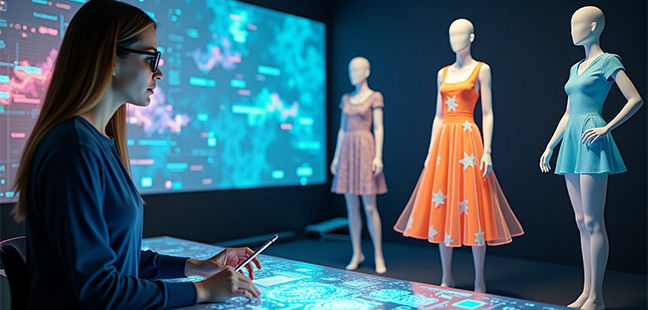
The new studio reality isn’t “AI versus designer.” It’s designer with a sharper set of instruments systems that can iterate silhouettes, propose material directions, and compress weeks of exploratory work into an afternoon without dissolving authorship. The craft is still couture: proportion, tension, taste. What changes is the tempo, and the number of doors you can open before you choose one.
In practice, ai fashion design becomes most useful when it’s treated like an assistant inside a disciplined pipeline: concept ideation feeds 3D garment simulation, which feeds fit validation on an avatar, which feeds editorial rendering or real-time XR output. The point isn’t to flood the room with options, it’s to reach better decisions faster, with fewer physical samples, and with clearer creative intent.
At Mimic Digital Fashion, we write and build from process clarity, editorial sensibility, engineered workflows, and language that stays fashion-first rather than hype-first.
Table of Contents
The New Creative Stack: Where AI Actually Fits

AI becomes valuable when you place it inside the same structure designers already trust: references → silhouette → material logic → fit → presentation.
Concept acceleration, not concept replacement Use generative image systems for moodboards, shape language, accessory directions, and styling permutations then curate hard. The “edit” is the designer’s signature.
Textile and surface ideation
Pattern drafts, print directions, embroidery maps, knit motifs, use AI as a sketching engine, then rebuild surfaces with production-minded constraints (repeat, scale, colorways, placement).
Design development support Turn a selected look into a measurable asset: block decisions, seam logic, trims, and closure intent. AI can suggest variations, but pattern discipline keeps it honest.
Digital sampling and fit logic
The real transformation happens when AI outputs don’t end as images. They become inputs to 3D garment simulation, where drape, weight, and movement expose what’s only “pretty” versus what’s wearable.
Editorial vs real-time outputsThe same garment can be lit for a photoreal campaign render or optimized for real-time XR. AI helps you explore; the pipeline decides how it ships.
From Prompt to Pattern: A Practical AI-to-3D Workflow

When ai fashion design is operational - not speculative, it follows a repeatable sequence that protects authorship and reduces rework.
Creative brief → constraint list
Define silhouette codes, brand references, target body, material families, and the “do-not-cross” lines (logos, protected motifs, off-brand proportions).
Generative exploration → curated boards
Generate broadly, then narrow ruthlessly: select 10–20 images that share a single design grammar. Treat outputs like reference photography useful, but not final.
Design translation → construction intent
Identify what must become real: neckline geometry, volume distribution, seam placement, layered components, fastening points, and articulation areas (elbow, knee, waist).
3D build → garment simulation
Draft or import patterns, assign fabric properties, and simulate. This is where the garment stops being a picture and starts being a product. Adjust tension maps, collision, and drape until it reads correctly in motion.
Avatar fitting → proportion truth
Fit on a digital fashion avatar (scanned, photogrammetry-derived, or standard). Validate balance, ease, and hem behavior across poses.
Motion + performance pass
For runway energy, apply motion capture or animation tests. If the garment fails under movement, fix the pattern not the camera.
Output finishing: editorial render or real-time XR
Editorial: high-resolution shading, cinematic lighting, micro-wrinkles, hair/skin realism.
Real-time: optimized topology, texture budgets, LOD strategy, and stable performance in AR/VR.
This is the difference between “AI imagery” and a production-grade digital garment pipeline - one survives scrutiny, fit, and motion.
Comparison Table
Approach | What it’s best at | Typical tools & assets | Output fidelity | Timeline impact | Trade-offs |
Traditional design (manual) | Deep craft, slow precision | Sketches, drapes, physical samples | High (physical truth) | Slowest | Costly sampling, limited iteration |
AI-assisted concepting | Rapid ideation + style exploration | Prompts, generated boards, curated references | Medium (image truth) | Fast | Needs strong curation; can drift off-brand |
AI-to-3D digital sampling | Wearability + fit validation | Patterns, 3D simulation, fabric presets, avatars | High (simulation truth) | Fast-to-medium | Requires technical pipeline discipline |
Real-time XR fashion pipeline | Immersive experiences + interactive try-on | Optimized meshes, PBR textures, AR/VR rigs | Variable (depends on budget) | Medium | Performance constraints shape aesthetics |
Hybrid editorial pipeline | Campaign-grade visuals + runway motion | Simulation + mocap + high-end rendering | Highest (visual truth) | Medium | Heavier production, more review stages |
Applications Across Industries

The most compelling work happens when AI-led exploration is tethered to a clear output: product, image, experience, or performance.
Brand concept development and capsule direction (rapid silhouette exploration and tightly curated boards) - this often begins inside a studio’s service framework, like the workflow-led approach outlined on our services.
Digital campaigns and lookbook production (photoreal garment rendering, controlled art direction) - see how finished work translates in a portfolio context.
Virtual try-on and e-commerce visualization (fit-aware assets, scalable content) - the strategic lens on virtual try-ons is explored here.
Entertainment costuming (CG characters, stylized realism, motion-tested garments for performance)
Gaming and real-time avatars (optimized garments that still hold couture-level design intent)
Experiential retail and immersive runway (AR mirrors, VR shows, interactive product storytelling)
Education and prototyping labs (teaching pattern logic through simulation before sampling)
Benefits of AI in Fashion Design
When ai fashion design is integrated into a real garment pipeline, the benefits are specific and measurable in decisions, not buzzwords.
More exploration with less waste: broader ideation without multiplying physical samples
Faster convergence: simulation and avatar fitting reveal problems early
Better cross-team communication: clearer visuals for stakeholders, merch, and production
Scalable content production: variants, colorways, and drops can be visualized with consistency
Stronger pre-production confidence: motion tests and drape behavior reduce surprises later
Challenges of AI in Fashion Design

AI can speed the studio up but it can also speed mistakes, ambiguity, and aesthetic dilution.
Authorship and originality: generated imagery must be treated as reference unless rights and provenance are clear
“Pretty but impossible” outputs: without construction logic, designs collapse at the simulation stage
Data and bias: body standards, styling norms, and material assumptions can harden if not actively corrected
Pipeline fragmentation: disconnected tools create rework (image → redraw → pattern → rebuild)
Real-time constraints: XR garments must be optimized without losing the couture read
Future Outlook

The next phase won’t be defined by bigger image models it will be defined by connected garment intelligence: systems that understand pattern geometry, fabric physics, and avatar biomechanics as first-class inputs.
Expect three parallel futures, often in the same brand:
Editorial pipelines get sharper: AI-assisted ideation feeding photoreal simulation, cinematic rendering, and runway-grade motion capture - built for campaigns where every fold is intentional.
Real-time pipelines get more elegant: better material approximation, faster cloth solvers, and smarter optimization so AR/VR assets don’t feel like compromises.
Digital garments become interoperable: a single source garment moving between design development, digital sampling, virtual try-on, and immersive experiences with fewer rebuilds.
If you want a lens into the technical side - how assets move between simulation, rendering, and real-time environments - the foundational stack is mapped through tech. And if you’re curious about the studio ethos behind those choices - why we prioritize craft discipline over novelty that context lives at mimic digital fashion.
FAQs
What is AI fashion design in a professional studio context?
It’s the use of machine-assisted ideation and automation inside a structured fashion pipeline supporting concept generation, variation exploration, and sometimes technical acceleration, while final authorship remains curated and directed by the designer.
Does AI replace patternmaking and garment construction?
No. It can propose silhouettes and surface directions, but wearability is proven through pattern logic, 3D garment simulation, and fit validation on avatars where construction intent becomes non-negotiable.
How do you keep a brand aesthetic consistent when using generative tools?
By setting constraints upfront (codes, references, “no-go” boundaries), generating broadly, and curating narrowly then translating the selected direction into patterns, fabric rules, and lighting language that match the brand.
What’s the difference between AI images and production-ready digital garments?
Images describe a look. Production assets behave: they drape, move, fit, and render consistently across angles and lighting often requiring simulation, proper materials, and motion tests.
Can AI help with virtual try-on?
Yes, but the strongest results come from fit-aware digital garments and calibrated avatars. AI can support content scale and styling variants, while the try-on experience depends on accurate garment behavior and body representation.
How do motion capture and AI intersect in fashion production?
AI can accelerate early ideation, while motion capture validates performance: walk cycles, turns, and dynamic poses reveal whether a garment holds its silhouette language under movement.
Is real-time AR/VR fashion lower quality than editorial renders?
Not inherently just constrained differently. Editorial favors heavy shading and micro-detail; real-time favors optimization, stable performance, and clever material approximation.
What should a brand build first: AI concepting or 3D simulation?
If the goal is fewer samples and better fit confidence, start with simulation and avatars. If the goal is faster visual direction-setting, start with concepting but plan the bridge to 3D early.
Conclusion
The most interesting shift isn’t that machines can generate images, it’s that creative teams can now move from direction to digital garment with less friction. When you treat AI as a disciplined part of the pipeline anchored in pattern logic, simulation truth, avatar fitting, and motion, you get speed and taste, iteration and intent.
That’s the studio standard we hold: editorial craft supported by technical realism, with workflows designed to carry a garment from concept to campaign, from runway motion to immersive space.

Comments