
Digital Fashion Portfolio: A Brand Case Study Guide

Can a digital fashion portfolio prove more than visual style?
A strong digital fashion portfolio shows how creative technology solves real brand problems. It connects photoreal garments, accessories, avatars, scanning, animation, and immersive experiences to decisions that matter: faster approvals, clearer product communication, reusable campaign assets, stronger buyer confidence, and memorable brand storytelling. For leaders evaluating a studio, the portfolio is evidence of both taste and production reliability.
This guide explains how to build and assess a digital fashion portfolio for commercial use. It complements Mimic Digital Fashion’s digital fashion services and public project portfolio.
Table of Contents
What a Digital Fashion Portfolio Must Prove

A digital fashion portfolio is a curated body of evidence showing how a team turns fashion ideas, physical products, people, and spaces into useful digital assets. It should not behave like a wall of unrelated beauty shots. It should reveal a repeatable capability: interpreting a brief, preserving product truth, selecting the right production method, directing a compelling visual language, and delivering files that work in the intended channel. For a fashion buyer, that distinction separates attractive experimentation from a reliable commercial partner.
The portfolio must provide four kinds of proof. Visual proof covers silhouette, materials, lighting, styling, grooming, and composition. Technical proof shows that geometry, textures, rigs, scans, and simulations are appropriate for the destination. Commercial proof connects the work to ecommerce, campaigns, sampling, customization, retail, or audience experience. Operational proof indicates that the result can be repeated across products, colorways, markets, and deadlines. Strong case studies communicate all four without overwhelming viewers with production jargon.
Context matters because different deliverables require different judgments. A cinematic render may be excellent campaign work but poor evidence for a lightweight real-time configurator. A mobile asset may contain less visible detail in a still yet perform perfectly in AR. Review each project against its purpose, audience, device, and next action. Credible work also reveals judgment about tradeoffs among realism, speed, interactivity, file weight, budget, rights, and approval risk.
Explore the studio’s technology ecosystem to see how 3D, scanning, motion, AI, and XR support different destinations.
Structure Every Case Study Around Business Value

Every case study should answer a practical sequence: What was the challenge? What did the team create? How was it produced? Where was it used? What changed as a result? This structure converts a visual portfolio into decision support. Prospective clients can recognize a problem similar to theirs and understand whether the asset was built for a real launch, product workflow, or customer journey instead of an isolated technical demonstration.
Start with context without overstating confidential information. Explain that a luxury accessories team needed photoreal product visuals before final samples, or that a campaign required a recognizable ambassador across rendered and real-time environments. Then state the production goal directly: reduce reshoots, enable variants, build an interactive experience, create a digital double, or prepare a product for several channels. Clear goals give every beautiful image a reason to exist.
Connect craft to purpose. Pattern-based simulation may preserve garment construction and drape. Scanning may capture the identity of a person or object. A custom rig may enable movement and future reuse. Real-time optimization may make a detailed asset accessible on mobile. Report defensible outcomes such as approved colorways, localized markets, platforms supported, sample rounds avoided, formats delivered, approval stages completed, or later projects that reused the master asset.
Close with the next-use story. Explain how the source asset could support a product page, social video, virtual showroom, AR activation, buyer presentation, or internal design review. This demonstrates that the studio considered naming, versions, rights, materials, source files, and export requirements rather than producing a one-off render that becomes difficult to update.
A deeper production reference is the 3D fashion design pipeline.
Show Product Accuracy and Creative Craft
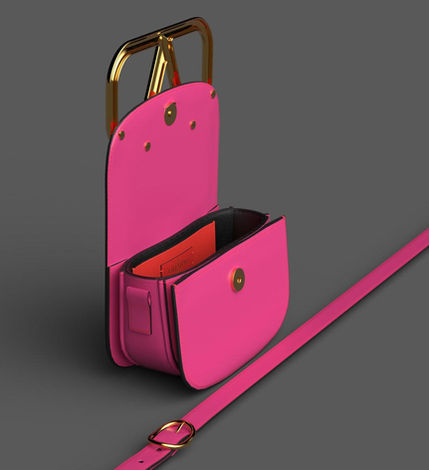
A persuasive digital fashion portfolio balances product truth with creative distinction. Product truth means the recognizable facts of a garment or accessory remain correct: proportion, construction, seams, closures, hardware, logos, surface finish, color, and material response. Creative distinction gives those facts emotional force through composition, styling, environment, movement, and narrative. When one side overwhelms the other, work may be technically precise but forgettable, or visually exciting but unsuitable for commerce.
For product-focused projects, include enough views to build confidence. A hero angle establishes desire, while a detail crop, alternate view, material close-up, or carefully selected breakdown reveals whether the asset can withstand scrutiny. With simulated clothing, show drape, tension, weight, and contact with the body. With avatars, show how clothing, anatomy, grooming, and performance integrate. Viewers should be able to see whether the project solved difficult connections between disciplines.
Consistency across a collection is often more commercially valuable than one perfect image. Ecommerce teams need products presented at comparable scale, angle, lighting, and color. Campaign teams need variants that preserve approved art direction. Show related products, colorways, or deliverables when permission allows. Use captions to identify scanning, modeling, simulation, texturing, grooming, rigging, animation, or full production, and label stylized work clearly.
Creative craft also includes restraint. Not every surface needs maximal gloss, every space needs spectacle, or every avatar needs dramatic motion. The strongest work directs attention toward the product and the brand idea. A portfolio earns confidence when projects feel different for meaningful reasons rooted in each brief rather than because one fashionable treatment was applied to every client.
See how this accuracy supports scalable content in the fashion visualization guide.
Present Process Without Exposing Confidential Work

Process makes expertise visible, but fashion work often contains unreleased products, proprietary patterns, campaign strategy, likeness rights, or partner technology. A useful digital fashion portfolio shares enough to demonstrate competence while respecting approvals. Use a layered disclosure model. Public, private, and live-review layers can give serious buyers increasing detail while preventing sensitive production files from circulating without control.
The public layer can include approved final images, a concise challenge, selected methods, credited collaborators, and broad outcomes. A private credentials deck can add breakdowns, before-and-after comparisons, alternate directions, specifications, and restricted work under appropriate terms. A live meeting can address deeper questions without distributing source material. When a client cannot be named, describe the category and problem precisely rather than implying credit for hidden work.
Apply the same discipline to AI. If generative tools contributed to ideation, variation, cleanup, or another stage, describe the role when it matters. Never present synthetic imagery as a photographed real product. Protect likeness, product, training-data, and usage rights, and keep human review responsible for accuracy, taste, cultural judgment, bias, and brand safety. Clear governance is a professional capability, not an obstacle to experimentation.
Credits strengthen a portfolio. Identify whether the studio led the complete project or supplied a specialist discipline. Credit agencies, designers, production partners, photographers, and technology teams according to agreement. Experienced clients understand collaboration; they need to know which capability they are evaluating and whether the team handles partner relationships responsibly.
Learn more about the studio’s background on the About Mimic Digital Fashion page.
Build Channel-Ready Proof for Commerce and XR

A modern digital fashion portfolio should show what happens after a master asset is approved. One garment or accessory may become a high-resolution campaign render, lightweight web viewer, AR try-on element, animated social asset, real-time showroom object, or localized ecommerce visual. These derivatives have different requirements. The portfolio should make adaptability visible so clients can see whether one investment can support a connected content system instead of disconnected outputs.
For ecommerce, emphasize accurate color, comparable views, product detail, load performance, and a clear relationship between the representation and the item sold. For campaign motion, demonstrate silhouette readability, believable materials, pacing, framing, and adaptation to vertical and horizontal formats. For interactive 3D, show responsive rotation, configuration, material changes, and device performance. Each example should reflect the customer behavior expected in that channel.
Immersive work must be judged by journey design as well as atmosphere. A virtual environment needs orientation, product discovery, readable interaction, accessibility, and a meaningful next action. If visitors can admire a collection but cannot inspect an item, request information, save a look, or reach a product page, the experience may not support the commercial goal. Show how asset quality, interface behavior, and conversion paths work together.
List delivered formats and destinations without burying readers in specifications. Mention stills, animation, web 3D, AR, VR, game-engine assets, or source files prepared for later reuse. When relevant, summarize the optimization challenge: preserving silhouette, product identity, and material character while reducing geometry, texture size, or runtime cost. This proves that deployment was considered from the start.
See how immersive assets support buyer journeys in the virtual fashion showroom playbook.
Related planning can draw on 3D fashion asset management for governance and reuse.
Customization requirements are explained in the 3D fashion configurator guide.
Product-page applications are covered in the digital fashion ecommerce guide.
View the studio’s current digital fashion project portfolio for examples.
FAQ
What should a digital fashion portfolio include?
Selected case studies should explain the challenge, approach, finished assets, channels, and defensible outcomes. Together they should prove product accuracy, creative judgment, technical capability, and reuse.
How many projects should it contain?
Six to twelve strong case studies can be enough when they match the services being sold. A shorter tailored selection is usually more persuasive than an unfiltered archive.
Should it show process or only final renders?
Show both, but make process evidence purposeful. Include only the breakdowns, scans, simulations, alternate views, or notes that help a buyer understand accuracy and reliability.
How can confidential projects be shown?
Use approved public material, specific anonymized descriptions, private credentials for restricted details, and live walkthroughs under suitable confidentiality terms.
What makes a 3D fashion case study commercially credible?
It connects the asset to a real use such as sampling, ecommerce, campaigns, customization, virtual try-on, or immersive retail, then reports outcomes that can be supported.
Should a portfolio include AI-assisted work?
Only when relevant and presented accurately. Explain the role of AI, protect product and likeness rights, and show where human direction and quality review controlled the result.
How do brands evaluate product accuracy?
Review proportion, construction, seams, materials, trims, logos, color, and lighting across several views. For simulated clothing, inspect drape, weight, collision, and body contact.
How often should the portfolio be updated?
Review it quarterly and after major launches. Add approved outcomes, remove weaker work, repair media, and tailor the selection to services currently being sold.
Can one portfolio serve ecommerce, gaming, and XR clients?
A master library can support all three, but the public selection should be filtered by audience. Each buyer needs relevant proof, constraints, terminology, and outcomes.
Conclusion
A digital fashion portfolio is most persuasive when it functions as a series of compact business cases. Beautiful images open the conversation, but clear challenges, product accuracy, creative judgment, production logic, channel readiness, and honest outcomes create confidence. Curate the work around the buyer’s decision and show how each approved asset can continue delivering value after its first launch.
Ready to create portfolio-worthy digital fashion experiences? Explore Mimic Digital Fashion’s services and start a focused project conversation.

Comments