
Fashion Visualization: Why 3D and CGI Are Essential for Modern Fashion Marketing

Fashion marketing has always been a language of images - but the medium has changed. Today, the most persuasive imagery is no longer limited by geography, sample availability, or a studio calendar. It is engineered: sculpted through 3D garment simulation, lit in virtual sets, and refined into photoreal CGI frames that can scale across campaigns, e-commerce, and immersive experiences. In this new reality, fashion visualization is not decoration; it’s production.
What makes 3D and CGI essential isn’t novelty. It’s control. Control over silhouette accuracy, fabric behavior, color fidelity, and environment—across seasons, regions, and platforms. A brand can iterate on a look before a physical sample exists, build continuity across global content, and maintain an editorial signature while moving at the speed of digital commerce. When brands partner with studios that understand both fashion and pipeline craft—like the workflows outlined through Mimic Digital Fashion’s practice on the https://www.mimicdigitalfashion.com/—the output doesn’t feel “digital.” It simply feels inevitable.
This is where CGI stops being a technical shortcut and becomes a creative discipline: a fashion-native method for building consistent imagery, trialing concepts, and delivering high-end visuals for a world that expects immediate, screen-perfect storytelling. And as virtual try-ons, XR retail, and AI-assisted design continue to mature, visualization becomes the connective tissue between product, brand narrative, and customer experience.
Table of Contents
The New Standard: Why Fashion Needs Digital-First Imagery

Modern fashion is marketed in fragments: a product page hero, a carousel crop, a motion loop, a virtual storefront, a creator-style short. Each fragment must still feel like the same world. That cohesion is difficult when imagery is produced across multiple shoots, teams, and time zones.
A 3D-based content pipeline brings fashion marketing back under one roof—digitally. When garments exist as simulation-ready assets, brands can create a continuous stream of visuals without re-shooting the same look for every channel. This is where fashion visualization shifts from an occasional “nice to have” into the foundation of scalable imagery.
What a digital-first approach enables:
Pre-sample storytelling: visualize silhouettes and fabric drape before physical production is finalized.
Colorway precision: develop color-consistent imagery across markets without last-minute reshoots.
World-building continuity: reuse the same virtual set language for campaigns, drops, and capsules.
Fewer bottlenecks: reduce dependency on shipping, studios, and model availability.
Asset reuse: render a new angle, crop, or motion pass from the same master scene.
For brands building toward virtual try-on and immersive retail, this is not a separate track—it’s the same continuum. If you’re already exploring where this is heading, Mimic’s thinking on the future of virtual try-ons is a natural adjacent read: https://www.mimicdigitalfashion.com/post/future-of-fashion-and-virtual-try-ons
3D and CGI as a Marketing Engine
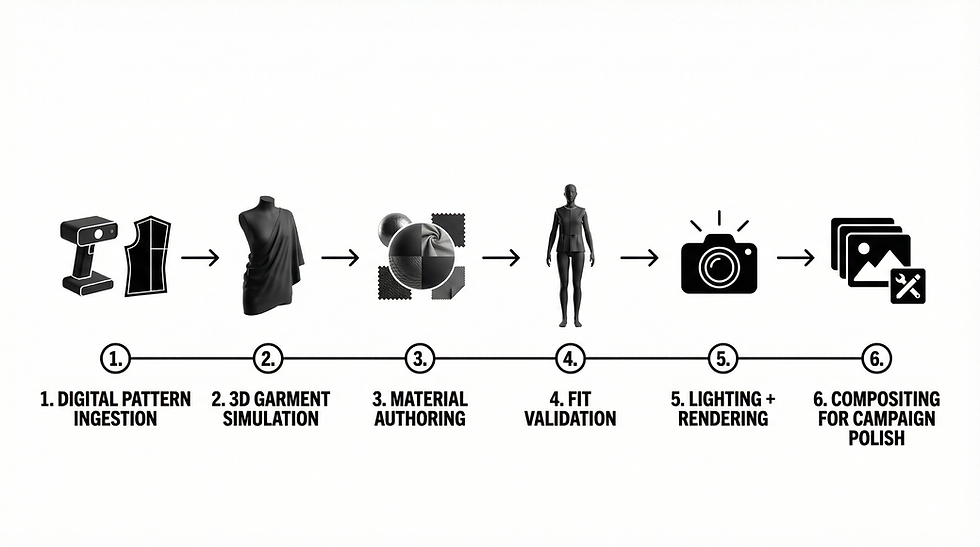
Traditional fashion imagery is captured. CGI fashion imagery is constructed. That difference matters because marketing is rarely about the garment alone—it’s about the garment within a controlled, repeatable world.
A robust CGI workflow typically includes:
Digital pattern ingestion (from tech packs, 2D patterns, or reconstruction)
3D garment simulation (cloth behavior, seam tension, layering logic)
Material authoring (weave detail, specularity, translucency, micro-wrinkles)
Fit validation on a digital mannequin or fashion-grade avatar
Lighting + rendering (studio-grade, editorial grade, or stylized)
Compositing for campaign polish (skin, hair, grade, atmosphere, lens language)
What makes this a marketing engine is iteration. A brand can test a hem length, swap a knit density, or re-light a scene for a new region—without rebooking anything. When the goal is consistent output across seasons, teams often move from ad hoc visuals into a structured service pipeline—exactly what’s reflected in the way Mimic frames production through its services: https://www.mimicdigitalfashion.com/services
And when the objective becomes customer-facing interactivity—like “try before you buy” experiences—the same assets can feed the next layer of experience design. For a deeper view of that shift, this breakdown of virtual try-on technology maps the transformation well: https://www.mimicdigitalfashion.com/post/how-virtual-try-on-technology-is-revolutionizing-the-future-of-digital-fashion
Photorealism vs Stylization: Choosing the Right Visual Language

Not every brand needs the same degree of realism. The smarter question is: what does the audience need to believe?
Photoreal CGI is ideal when:
You need e-commerce trust: true-to-life fabric, accurate color, credible fit
You’re matching physical product photography across a grid
You’re launching with minimal sample inventory
You need consistency across global markets and SKUs
Stylized 3D visuals excel when:
You’re building a conceptual campaign world
You want graphic silhouettes, sculptural light, or surreal staging
You’re designing for social velocity rather than catalog accuracy
You’re bridging fashion and culture—music, gaming, performance, digital art
Both still rely on the same craft foundation: simulation, material truth, and lighting discipline. The difference is intent. In high-fashion contexts, stylization can be as precise as realism—just aimed at emotion rather than verification.
Editorial Pipeline vs Real-Time Pipeline

A key distinction in modern visualization is production intent.
Editorial pipeline (offline rendering, compositing, cinema-grade frames) is for:
Campaign stills
Lookbooks
Product heroes
Premium motion spots
High-impact brand films
Real-time pipeline (engine-driven, interactive, responsive) is for:
Virtual try-on systems
AR retail overlays
VR fashion environments
Immersive runway worlds
Live configurators and interactive retail
Brands increasingly need both. The same garment asset may be rendered for a campaign today, and optimized for real-time tomorrow. That duality shows up most clearly in XR fashion contexts—where virtual spaces become stages. For an editorial view into that direction, explore how VR fashion reshapes presentation: https://www.mimicdigitalfashion.com/post/virtual-reality-fashion
Comparison Table
Approach | Best For | Pipeline Core | Strength | Limitation |
Traditional photo shoot | Heritage campaigns, tactile storytelling | Studio, styling, physical samples | Organic nuance, cultural cachet | Slow iteration, high logistics |
Photoreal CGI renders | E-commerce, global consistency, pre-sample launches | 3D simulation, materials, offline rendering | Scalable, repeatable, accurate | Requires strong asset craft |
Stylized 3D campaigns | Concept drops, editorial worlds | Art direction, lighting design, CG environments | Distinctive visual identity | Can sacrifice product verification |
Real-time visualization (XR) | AR/VR retail, interactive fashion | Engine optimization, shaders, performance | Immersive + responsive | Fidelity trade-offs if rushed |
Hybrid (photo + CGI) | High-end campaigns with flexibility | Capture + CG augmentation | Best of both worlds | Needs tight creative supervision |
Applications Across Industries

Fashion visualization isn’t confined to runway brands. The same pipeline logic scales across adjacent industries where style, fit, and desirability are visual-first.
Real-world applications include:
Luxury & premium fashion: pre-sample campaigns, seasonal drop visuals, world-building sets
E-commerce & DTC: consistent packshots, variant rendering, motion loops for PDPs
Beauty & accessories: reflective materials, macro detail, controlled lighting
Retail & experiential: interactive product displays, virtual store windows, immersive activations
Sportswear & performance: fit validation on dynamic poses, motion-ready visualization
Entertainment & music: digital wardrobe for performances, avatars, and stage worlds
Gaming & virtual worlds: wearable assets for platforms and brand collaborations
Education & R&D: design iteration, material tests, rapid prototyping visuals
For brands bridging into AR overlays—where garments and accessories extend into the camera-native world—this perspective on augmented reality fashion aligns with where visualization becomes experiential: https://www.mimicdigitalfashion.com/post/augmented-reality-fashion
Benefits

When executed with fashion-grade craft, CGI and 3D deliver more than efficiency—they deliver precision.
Core advantages:
Speed to market: launch visuals before full sample sets exist
Creative control: art direction stays consistent across regions and teams
Cost stability: fewer shoot variables, less reshooting
Asset longevity: one garment build fuels stills, motion, and XR
Fit and drape credibility: simulation reveals how materials behave in movement
Scalable variation: new colorways, trims, and styling without a new production day
Platform readiness: outputs for e-commerce, social, immersive retail, and editorial
This is also where AI-assisted design begins to intersect—less as a replacement for taste, more as a multiplier for iteration. Mimic’s view on AI in fashion design provides useful context for how the workflow is evolving: https://www.mimicdigitalfashion.com/post/ai-fashion-design
Challenges
The promise of 3D content is real, but so are the pitfalls—especially when the process is treated as “software output” rather than craft.
Common challenges:
Asset quality variance: low-fidelity builds undermine brand trust faster than no CGI at all
Material truth: fabrics need nuanced shader work, not generic presets
Pattern accuracy: poor pattern data produces unrealistic fit and silhouette
Pipeline fragmentation: disconnected teams cause inconsistencies across channels
Approval culture: brands must learn to approve digital samples with clear criteria
Real-time constraints: engine optimization can reduce realism if not planned early
Creative direction drift: CGI needs the same styling and art direction rigor as shoots
The solution is not simply “use 3D.” It’s to treat it as a fashion-native production discipline—with standards for drape, silhouette, surface, and lighting.
Future Outlook

The future of fashion marketing is not a single medium—it’s a connected system. CGI stills, simulation-driven motion, and XR experiences are converging around shared assets. That convergence is what makes fashion visualization strategically essential: it becomes the core format from which everything else is derived.
Three shifts are accelerating:
Digital garments as master files: one build supports editorial renders, e-commerce, and real-time experiences.
Virtual runways as content engines: motion capture and performance-ready avatars turn runway language into scalable visual narratives.
Real-time and editorial pipelines collaborating: the industry is learning when to push fidelity (offline) and when to push interaction (engine).
The most forward brands will treat visualization as product infrastructure—alongside design, merchandising, and marketing. And as virtual clothing markets expand, the distinction between “marketing image” and “digital product” becomes increasingly blurred. This is explored clearly in Mimic’s look at virtual clothing as a rising market force: https://www.mimicdigitalfashion.com/post/digital-fashion-why-virtual-clothing-is-becoming-the-next-big-market
FAQs
What is fashion visualization in a modern marketing context?
It’s the craft of communicating a garment’s design, fit, and mood through engineered imagery—often using 3D simulation, CGI rendering, and compositing to create consistent visuals across channels.
How does CGI improve e-commerce performance?
High-quality renders can maintain consistent lighting, color fidelity, and angle coverage across SKUs—supporting trust on product pages while enabling faster iteration and variant creation.
Can 3D replace traditional fashion photography?
It can replace parts of it—especially for consistency, speed, and pre-sample needs. Many brands adopt a hybrid approach: physical capture for cultural texture, CGI for scalability and control.
What makes a 3D garment look “real”?
Accurate patterns, correct cloth simulation parameters, high-fidelity materials, and fashion-grade lighting. Realism is less about polygon count and more about textile truth and direction.
How early can brands start using 3D in the design cycle?
Very early—often from pattern and material decisions. Early visualization supports design iteration, merchandising alignment, and marketing prep before sampling is complete.
What’s the difference between CGI visuals and virtual try-on assets?
CGI visuals prioritize frame quality for marketing; virtual try-on assets prioritize performance and interaction. Ideally, both originate from a shared garment build, optimized for each output.
Does fashion visualization work for accessories and footwear?
Yes—often extremely well. Hard-surface items like shoes, bags, and eyewear benefit from controlled reflections, macro detail, and consistent presentation across variants.
How do AR and VR change what “marketing” means for fashion?
They turn marketing into experience. Instead of showing a look, brands can let audiences engage with it—through interactive try-ons, immersive runways, and spatial retail environments.
Conclusion
Fashion has never been only about clothing. It’s about how clothing is seen—how it moves, catches light, holds shape, and suggests identity. In a screen-first world, that “how it is seen” must be designed with the same rigor as the garment itself. That is the real role of fashion visualization: not a trend, but a new standard of fashion communication.
3D and CGI are essential because they give brands control over craft at scale—drape, silhouette, material truth, and world-building continuity—without sacrificing speed. When done properly, the result isn’t tech-forward for the sake of it. It’s simply fashion-forward: precise, cinematic, and ready for every platform the audience lives on.

Comments